by Kristan Hill, Director of Marketing & Strategic Alliances
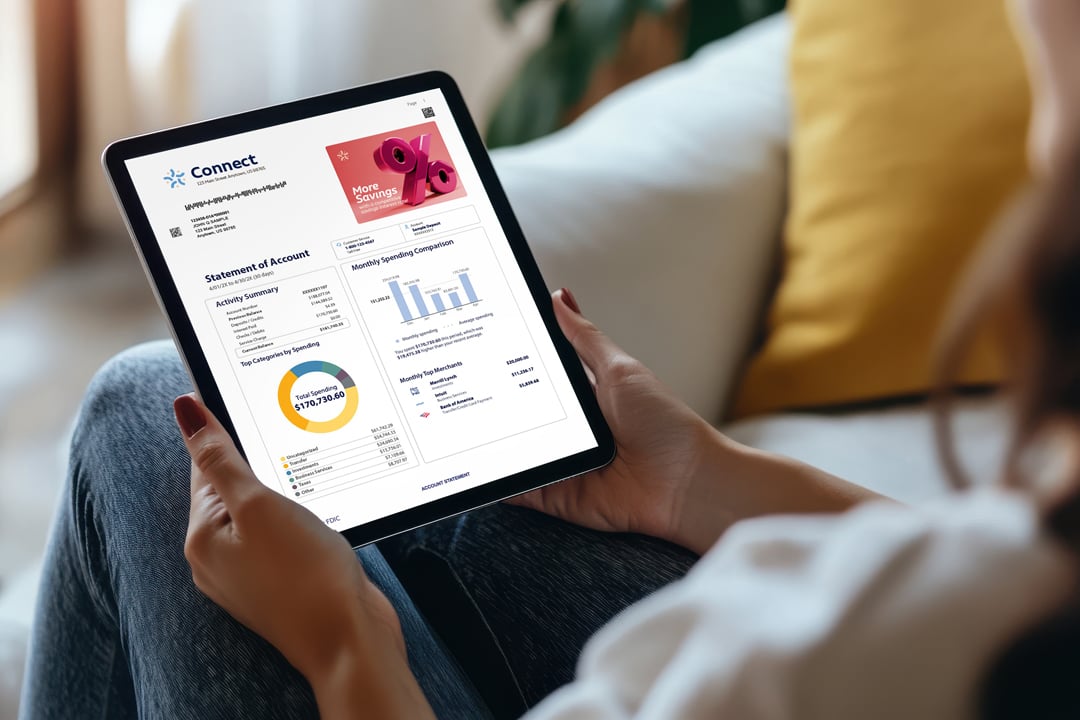
Every month, your institution sends a message that nearly every customer or member reads: their account statement. Whether it’s delivered digitally, printed and mailed, or accessed in a mobile app, statements remain one of the most consistent, high-engagement touchpoints in financial services. Yet too often, they’re treated as a regulatory requirement instead of a marketing asset.
With a thoughtful strategy built on segmentation, personalization, and consistent branding, statements can become one of your most powerful marketing tools, helping you cross-sell services, deepen relationships, and strengthen your brand across every channel.
Here’s how leading institutions are turning this underutilized space into a driver of growth and engagement.
Start with Segmentation: Speak to the Right Audience
Not all customers or members are alike, and neither should their communications be. Effective segmentation enables you to match the right message to the right audience, increasing relevance and response rates.
Research shows that segmented campaigns can generate up to 760% more revenue than non-segmented ones, and that customers are 76% more likely to feel frustrated when their interactions aren’t personalized. For community financial institutions, where personal connection is part of the brand promise, segmentation is both a data strategy and a loyalty strategy.
1. Demographic Segmentation: Start simple - age, income, and geography are powerful variables. A young professional in an urban area will likely have very different financial priorities than a retiree in a rural market. By targeting content accordingly, you can feature first-time homebuyer programs for younger audiences, home equity products for established families, or digital banking tips for retirees exploring online tools.
2. Behavioral Segmentation: Behavioral data, such as transaction history, product usage, and channel engagement, reveals how customers interact with your institution. For instance, a customer who actively uses mobile deposit but hasn’t signed up for e-statements may be a great candidate for digital adoption campaigns. Meanwhile, a member with multiple loan accounts might be primed for a cross-sell on credit protection services.
3. Life-Stage Segmentation: Customers’ financial needs evolve with life events - graduating, buying a home, starting a family, or preparing for retirement. Mapping messaging to life stages ensures your statement marketing stays relevant.
The key is to make every message meant for them.
Align with Strategic Goals and the Marketing Calendar
Statement marketing shouldn’t happen in isolation. It’s most effective when aligned with your institution’s broader goals and campaign calendar.
Launchig a new mortgage product in the spring? Use statement onserts/banners to reinforce that campaign. Promoting digital wallet adoption? Include a QR code that links directly to the app store download page.
By coordinating messaging across channels, your marketing efforts feel seamless and intentional, helping customers connect the dots between your brand, your products, and their needs.
Research shows that integrated campaigns using three or more channels deliver 287% higher purchase rates than single-channel efforts. Statements and e-statements fit naturally within that ecosystem, reinforcing brand messages customers already see on your website, in social media, or at the branch.
Keep Messaging Fresh to Avoid “Banner Blindness”
Even the best creative can lose impact over time if it doesn’t change. The human brain is wired to tune out what it perceives as repetitive or irrelevant - a phenomenon known as “banner blindness.”
Nielsen Norman Group has found that users “ignore anything that looks like an ad,” especially when it appears in the same place repeatedly. That means your statement design and promotional modules should evolve regularly.
The fix is simple: build variation into your statement strategy. Create two or three versions of each campaign message and test them. Track which creative drives more QR scans or web visits. Swap out hero graphics quarterly to keep visuals fresh.
By treating your statement as a living marketing channel rather than static content, you’ll maintain customer attention and drive measurable engagement.
Focus on Personalization and Consistency
Personalization is no longer a nice-to-have; it’s an expectation. According to McKinsey, companies that excel at personalization generate 40% more revenue from those activities than average performers.
For financial institutions, personalization can take many forms:
• Name-level messaging: Address customers by name in digital and printed statements.
• Product relevance: Promote only the products that fit their profile.
• Local context: Highlight nearby branches or community events tied to their ZIP code.
• Behavioral triggers: Feature mobile banking tutorials for users who have yet to download your app.
At the same time, maintain brand consistency across all channels. Research shows consistent branding can boost revenue by 10–33%. Whether a customer opens a printed statement, views it online, or scans a QR code, every visual and tone element should feel unmistakably yours.
Optimize Calls to Action
Once you’ve captured attention, make it easy to act. Each statement should feature clear, compelling calls to action with simple instructions such as:
• “Scan this QR code to start your mortgage pre-approval.”
• “Visit our site to open your high-yield savings account.”
• “Call your local branch to schedule a financial check-up.”
Transactional communications already outperform traditional marketing channels. Studies show they can achieve up to eight times higher open and click rates than standard promotional emails. That’s because customers trust and engage with messages tied to their accounts.
By integrating actionable CTAs into your statements, you tap into this built-in engagement and move customers one step closer to conversion.
Don’t Forget to Measure and Learn
The beauty of modern statement marketing lies in its measurability. Track QR code scans, landing-page visits, form completions, and conversion rates for each campaign. Break down results by segment to see what resonates most with each audience.
Run A/B tests with different headlines, images, and CTAs. Even small tweaks, like adjusting color contrast or button placement, can yield surprising lifts in response.
And most importantly, close the loop. Feed those insights back into your next campaign cycle. Over time, you’ll build a data-driven statement marketing program that grows smarter with every iteration.
-2.png?width=1344&height=350&name=HC3%20Logo%20(Full)-2.png)